Guides
Berlin, Leipzig/Halle or Dresden: arriving in eastern Germany
All three have a railway station in or under the building. That is the honest starting point.
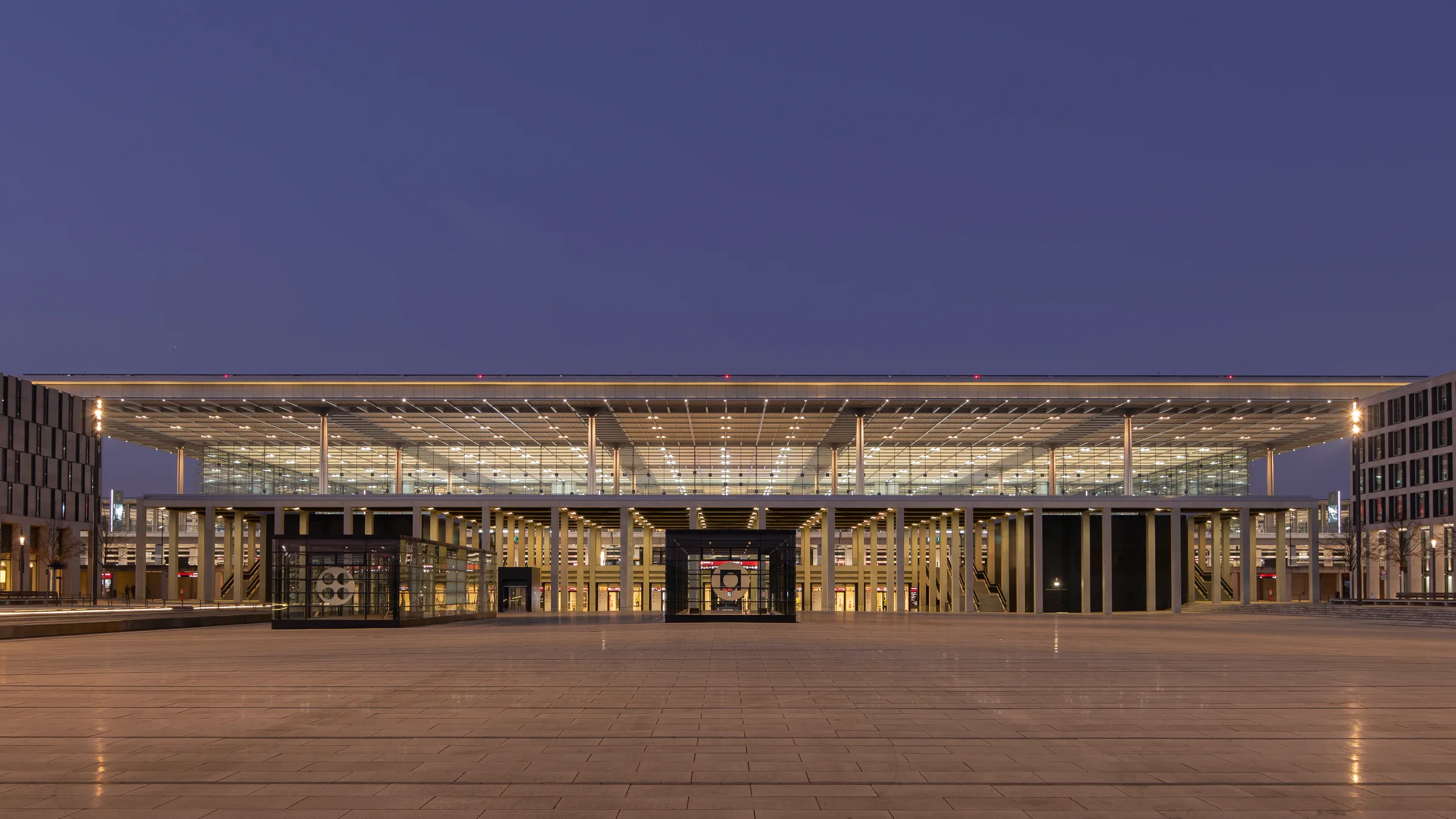
Berlin Brandenburg, Leipzig/Halle and Dresden between them cover most of eastern Germany, and all three are unusually well connected to their own cities. BER has the station beneath Terminal 1. Leipzig/Halle has its own long-distance station. Dresden’s S-Bahn platform is in the basement of the terminal.
Start by admitting the trains are good
If your destination is central Berlin, central Leipzig or central Dresden and you are travelling light, take the train. We would rather say that than sell you a car you do not need, and at all three airports the connection is genuinely strong rather than merely present.
Dresden is the clearest case: the S2 leaves from a platform in the basement of the terminal every half hour and reaches the two central stations in roughly thirteen and twenty-three minutes. Berlin’s Flughafenexpress from under Terminal 1 is fast and frequent. Leipzig/Halle has a long-distance station of its own with quick services into Leipzig Hauptbahnhof.
That is unusual. Several western German airports have worse links to bigger cities, and it is worth knowing before you assume an eastern German arrival needs a car arranged in advance.
What separates them beyond the city centre
Berlin is enormous and low-rise — roughly nine times the area of Paris — with no single centre. An address in Spandau, Pankow or Köpenick turns an airport train into a change plus a tram, with your cases, at whatever hour you happen to land. The city’s shape, not the quality of its transport, is what makes the difference here.
Leipzig/Halle belongs to two cities 20 km apart and serves Halle noticeably less well than Leipzig. If Halle is your destination the comparison is much closer than the timetable suggests. It is also the second-busiest cargo airport in Germany and works through the night, so passenger arrivals land at hours the passenger timetable is not built around.
Dresden is the smallest and the best placed for what surrounds it. Saxon Switzerland starts about half an hour away, Meissen is close, and the sandstone villages along the Elbe are the sort of address where the valley line runs out and nothing replaces it.
The cross-border dimension
Dresden to Prague is worth flagging on its own. Prague is closer to Dresden than Munich is, reached directly on the A17, and it is a genuine international transfer rather than a long local one. The rail route exists but involves a change and a border, and it is not fast.
The Czech spa towns — Karlovy Vary, Teplice — have the same shape. So does the run from Leipzig or Dresden toward Poland in the other direction. These are the journeys where a car stops competing with a good train and starts competing with an awkward multi-leg trip.
A practical note: carry your passport or national ID. It is a border crossing even inside Schengen, and spot checks happen.
The freight hours nobody plans for
Leipzig/Halle is the fourth-busiest cargo airport in Europe and has the highest number of freight-only movements in the EU. It runs through the night without the restrictions a city airport lives under, and passenger flights sit inside that operation.
The consequence for a passenger is simple and easy to overlook: landing at three in the morning is unremarkable here, and the station beneath you is at its emptiest at exactly that hour. The excellent daytime connection tells you nothing about the overnight one.
Berlin has a version of the same problem at Terminal 2, where low-cost schedules push departures early and arrivals late. A 06:00 flight means being at BER around 04:30, which is before the network is useful from most of a very large city.
What to take from this
- All three airports have a station at or under the terminal. For the city centres, take the train — the connections are genuinely good.
- Dresden’s S2 reaches the central stations in ~13 and ~23 minutes from a basement platform.
- Berlin is huge and centreless: Spandau, Pankow and Köpenick mean a change plus a tram.
- Leipzig/Halle serves Halle noticeably worse than Leipzig, despite both being ~20 km away.
- Prague is closer to Dresden than Munich is, direct on the A17 — a real international transfer.
- Leipzig/Halle is a night-working freight hub. The good daytime rail link says nothing about 03:00.
FAQ
Questions this raises
Do Berlin, Leipzig and Dresden airports have railway stations?
All three. BER has a station beneath Terminal 1, Leipzig/Halle has its own long-distance station, and Dresden’s S-Bahn platform is in the basement of the terminal. For city-centre destinations these are usually the right choice.
Is a transfer worth it from BER into Berlin?
Not to Mitte or anywhere else near a main station — take the Flughafenexpress. It becomes worthwhile for the rest of Berlin, which given the city’s size and lack of a single centre is most of it: Spandau, Pankow, Köpenick and the outer districts all mean a change and usually a tram.
How far is Prague from Dresden Airport?
Closer than Munich is. The A17 runs south from Dresden to the Czech border and on toward Prague, making it a direct drive rather than a multi-leg journey. It is quoted as its own route — and take your passport or ID, since it is still a border crossing.
Why do flights arrive at Leipzig/Halle in the middle of the night?
Because it is primarily a freight airport — the second-busiest in Germany and fourth in Europe — with no night-time restrictions. Passenger flights sit inside a nocturnal operation, so small-hours arrivals are normal here in a way they are not at a city airport.
Read next
- From the gate to the city centre at all nineteen German airports At most of these airports the train wins. We would rather tell you which ones than sell you a car you do not need.
- Uber, Bolt, FreeNow and the German taxi: what actually picks you up Uber exists here. It is a different product from the one on your phone at home, and the reason is a law rather than a business decision.
- Airport shuttles in Germany: which ones are real, and when to take them A shuttle is a shared bus on a timetable. Eight German airports have a real one — and at three of them you should take it.