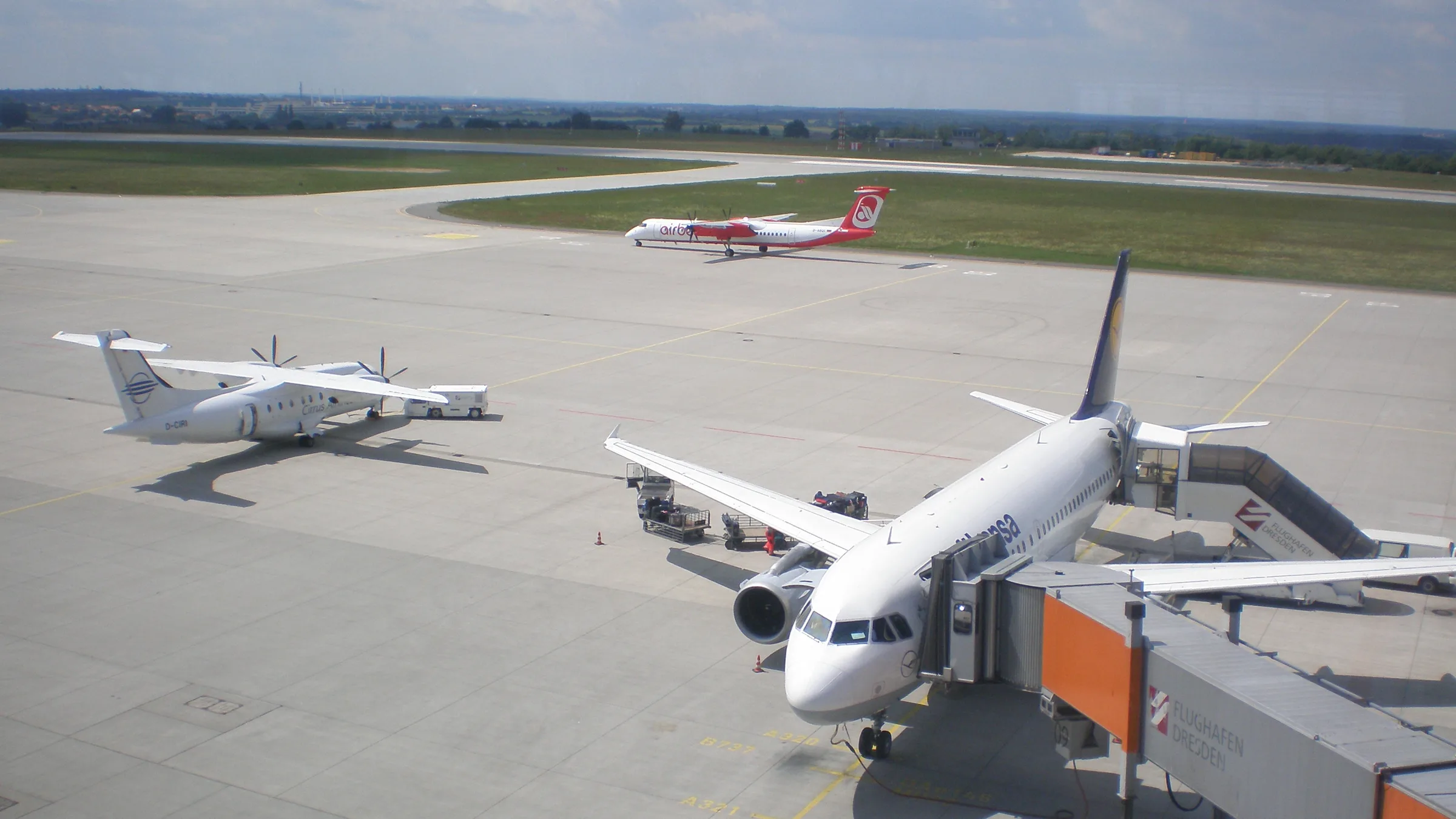
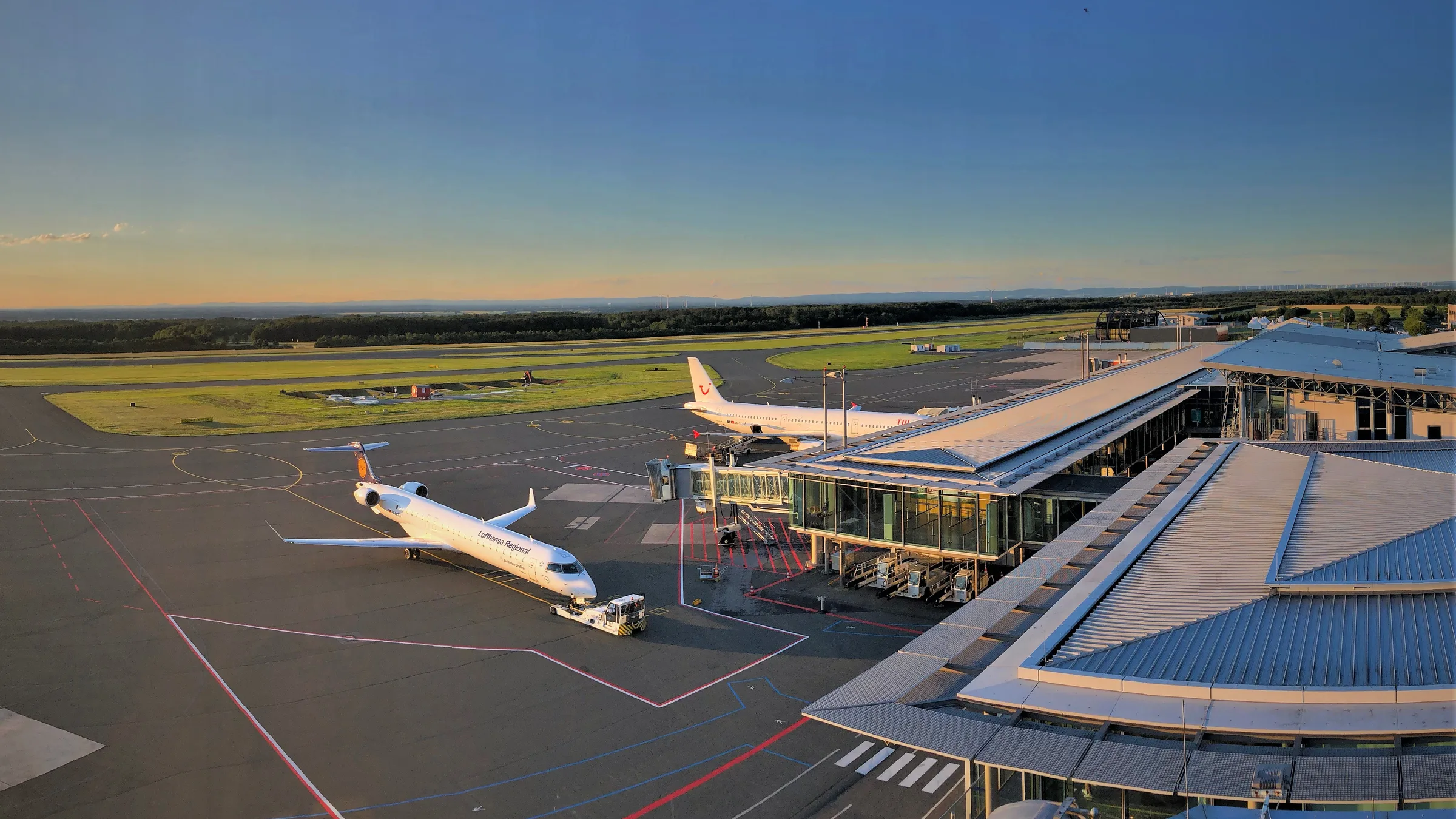
Dresden has one terminal, seven jet-bridge stands and a railway station in the basement of the building — which is unusual enough to be the first thing worth saying about it. Very few airports put the platform directly under the arrivals hall, and it makes the train genuinely competitive here in a way it is not at most regional airports.
The airport is 9 km north of the centre, reached from the A4 that bypasses the city, with the A13 running north to Berlin and the A17 south to the Czech border. That last road is the one that shapes the transfer market here: Prague is closer to Dresden than Munich is, and the A17 makes it a straightforward drive rather than an expedition.
The other direction is Saxon Switzerland, the sandstone country along the Elbe, which starts about half an hour from the terminal. Bastei, Königstein and the walking villages of the Elbe gorge are all inside an hour, and almost none of them is a simple journey by public transport once you leave the main valley line.
Dresden itself is a compact baroque city with a serious tourist economy and a semiconductor industry on its edge — Silicon Saxony is one of Europe’s largest microelectronics clusters. That gives the airport an unusual mix for its size: culture visitors, high-value business travel, and a steady cross-border flow toward Bohemia.
The S2 leaves from under the terminal every half hour and reaches the two central stations in roughly thirteen and twenty-three minutes. For one person going into Dresden there is no argument to make against it, and we will not manufacture one.
A car matters for the things the S2 does not do. Saxon Switzerland and the villages along the Elbe, Meissen, Leipzig and Chemnitz all need changes, and the last leg to a walking village or a hotel in the gorge often has no evening service.
The cross-border run is the distinctive one. Prague and the Czech spa towns — Karlovy Vary, Teplice — are a genuine international transfer rather than a long local journey, and they are priced by route accordingly. The rail alternative exists but involves a change and a border, and it is not fast.
You are met in the arrivals area of the single terminal, with a name sign. Dresden has one passenger building, so there is no terminal to confuse and exactly one place the meeting point can be. The S-Bahn station is in the basement directly beneath you, which is worth knowing if you want to compare on the day. Flights are tracked from the number given at booking, and 60 minutes of free waiting after touchdown is included.
A single terminal with seven jet-bridge stands and one arrivals area. The railway station sits in the basement of the building, and you come up to the arrivals level from the platforms by escalator and lift — this is one of very few German airports where the train is genuinely underneath your feet rather than a walk or a shuttle away.
For meeting a flight by car, the short-stay car park PK1 is directly in front of the terminal and puts you less than a minute on foot from arrivals. PK2 sits alongside the building and is much the same. Neither is a long walk, which is unusual enough at a German airport to be worth stating.
The S2 is the honest alternative and a genuinely good one: every thirty minutes throughout the day, twenty-one minutes to Dresden Hauptbahnhof, at €2.30 to €2.90 on the VVO tariff. If you are travelling light to the Altstadt, take it. A car earns its price for Saxon Switzerland, the Erzgebirge, the run across to Prague, and any arrival outside the hours the S-Bahn runs.