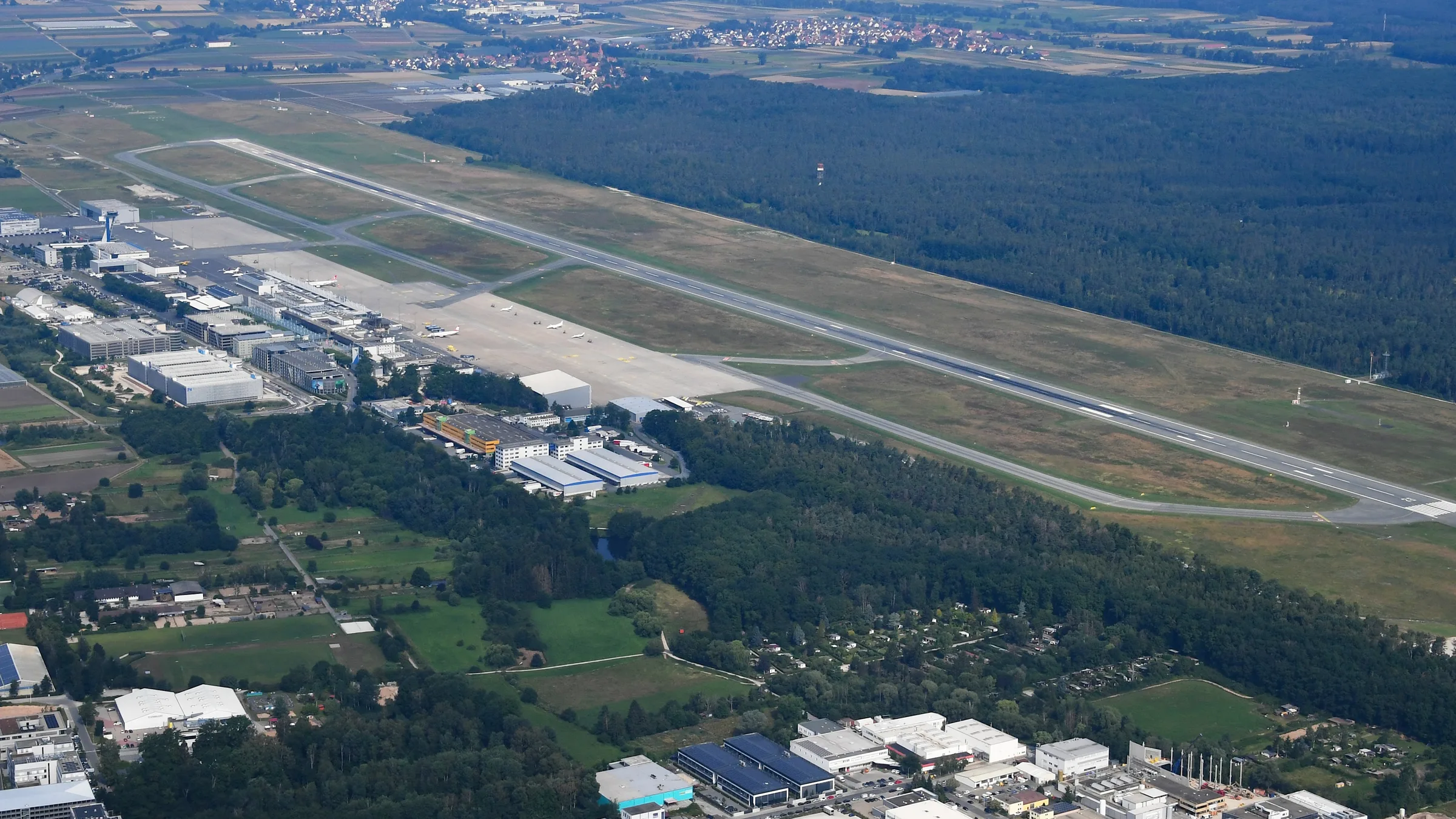
Five kilometres is the fact that matters here. Nuremberg Airport is almost inside the city, reached from the A3 with the A73 running in alongside, and it has two departure halls feeding a single arrivals hall linked landside and airside. One arrivals hall means one meeting point, with none of the module-and-terminal confusion of a larger hub.
That compactness is the whole experience of arriving. Baggage reclaim is quick, the walk from the belt to the door is short, and there is no internal transit system to negotiate. For a passenger who has just landed after a long day, an airport you can cross in five minutes is worth more than a longer list of shops.
The airport is the gateway to Franconia rather than only to Nuremberg. Erlangen and its medical and technology campus, Fürth, Bamberg, Würzburg and Ansbach are all closer to this airport than to Munich, and the region’s industry and universities sit in those towns rather than in a single centre. Siemens Healthineers at Erlangen alone generates a steady stream of business travel that has nothing to do with Nuremberg city centre.
Northern Bavaria behind it is also a tourist region in its own right — Bamberg and Würzburg are UNESCO sites, the Romantic Road starts nearby, and Franconian Switzerland is an hour away. Those are destinations where a rail journey involves changes and a final leg by bus that may not run when you land.
The U2 underground runs from beneath the terminal to the Hauptbahnhof in about twelve minutes, which for a single traveller heading into Nuremberg is unbeatable on both time and price. There is no honest argument for a car on that particular journey and we are not going to invent one.
What the U2 cannot do is leave the city. Erlangen, Fürth, Bamberg, Würzburg, Ansbach and Franconian Switzerland all need rail changes or have no direct service at all, and those are the transfers this airport is genuinely useful for. The pattern is consistent: a short distance on the map, an awkward journey in practice.
The other case is timing. The U-Bahn does not run through the night, and a first flight out means being at the terminal before it starts. Because a booked fare here does not change with the hour, an 05:00 pickup costs what a midday one costs — which is not true of the alternatives at that time of day.
You are met in the single arrivals hall, with a name sign. Nuremberg has two departure halls but only one arrivals hall, all linked landside and airside, so unlike a multi-terminal airport there is only one place the meeting point can be — and at 5 km from the city centre this is one of the easiest German airports to be collected from. Flights are tracked from the number you give at booking, and 60 minutes of free waiting after touchdown is included, which is generous at an airport where reclaim is this quick.
Two departure halls and a single arrivals hall, all linked land- and airside. There is exactly one place to be met, and at five kilometres from the city centre that makes Nuremberg one of the easiest German airports to be collected from: the walk from stand to exit is short, the reclaim is quick, and the door you come out of is never in question.
The kerb gives eight free minutes, metered by number-plate recognition at the entry, so there is no ticket to take and nothing to validate on the way out. The short-stay area P5 sits just beyond it for anything longer than a handover.
For one person heading into the Altstadt, the U2 is the honest answer. It runs from beneath the terminal to the Hauptbahnhof in about twelve minutes for a fraction of what a car costs, and five kilometres is not a distance that needs a private vehicle. We would rather point at it than argue with it. Where a car earns its price is a group with luggage, the Franconian towns the U-Bahn does not reach, the trade fair traffic the Messe generates, and the early and late edges of the schedule when the U-Bahn is not running.